When AI Gets Smarter, What Should Humans Do?
AI is getting smarter fast. The organizations deploying it are moving slower than the headlines suggest. And the humans who will thrive are the ones who stop competing against the machine and start using it as a lever.
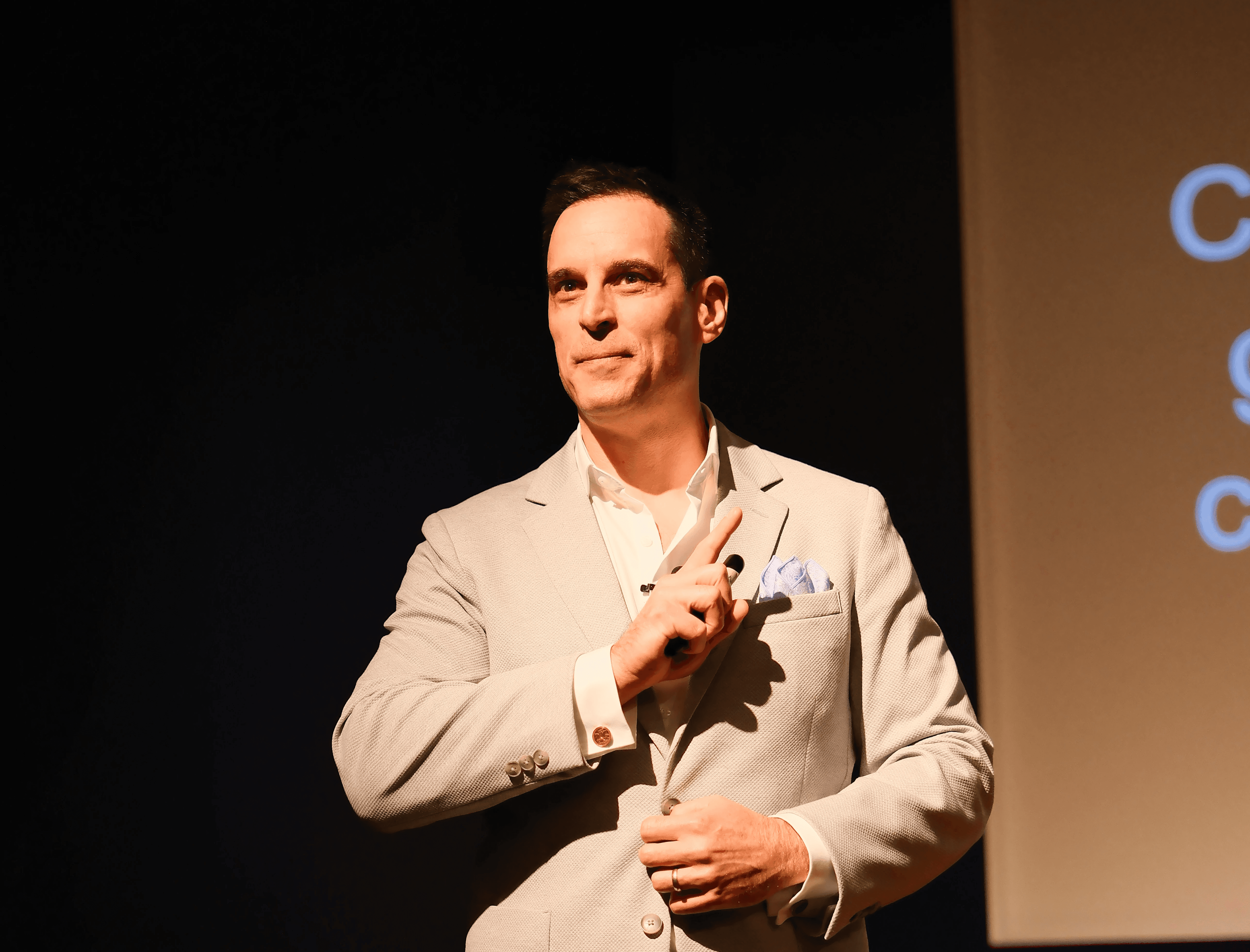
At Global Summit AI Vancouver 2026, Marc Low, Partner of Advisory in AI, Innovation and Emerging Tech at KPMG, delivered a talk that cut through the noise. Rather than leading with sensational headlines, he opened with a personal story: a late December night, kids asleep, deep in a rabbit hole of AI tools, mind racing with possibilities. It was the kind of moment, he said, that most people in the room had probably experienced at some point in their own AI journey. And from that moment of wonder, he asked the question that nobody wants to sit with: in a world where AI is getting dramatically more capable, what is the right response for the rest of us?
AI Capability Is Already Beyond What Most People Realize
Marc pointed to METR (metr.org), a benchmarking organization that measures how well AI systems complete real-world tasks. Their standard: can an AI successfully complete a task 80% of the time? Early models scored modestly. But over the past year, capability has grown at an exponential rate.
Today, using agent platforms like Claude Code, you can deploy multiple AI agents working in parallel toward a single objective. You go to sleep. You wake up to something close to a finished product. This is no longer a thought experiment. It is the daily reality for a growing number of practitioners.
“AI Will Replace Everyone” — How Much of That Is Actually True?
As AI capability climbed, a familiar narrative took hold in boardrooms and media alike: if AI can do all of this, we simply need fewer people. It is a narrative that triggers a deeply human response. Marc acknowledged he felt it too.
But he was direct about the gap between the brochure and the reality on the ground.
Having spent his career helping organizations actually deploy these systems, Marc described the typical enterprise AI rollout as, in his words, “a dumpster fire.” Codifying how organizations truly work is hard. Stitching systems together is harder. Getting people to adopt new tools while they are reading the same alarming headlines is harder still. In large legacy organizations, the pace of real AI adoption is far slower than the headlines suggest.
More fundamentally, AI can generate an answer. But deciding whether that answer is trustworthy, whether it is worth acting on, still requires a human. Remove people from the loop entirely, and you do not get better decisions. You get more noise.
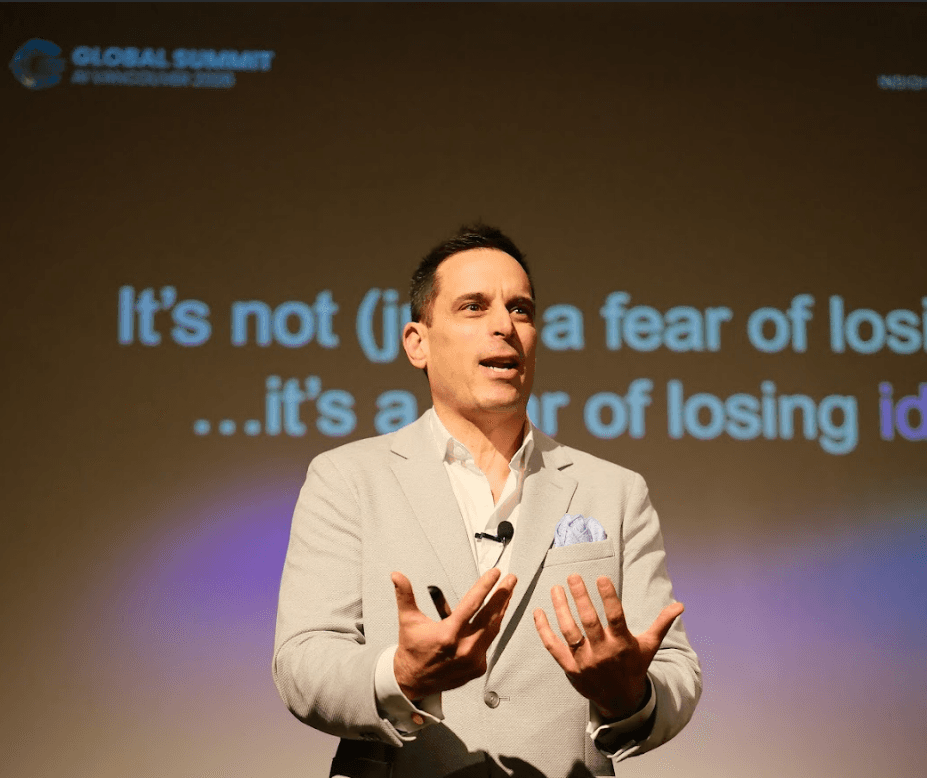
What Is Really Driving the Layoffs
Marc offered a pointed case study. When Jack Dorsey’s company Block announced it was cutting 40% of its workforce, the stock jumped roughly 25%. A few weeks later, many of those same employees were quietly brought back.
The lesson is not that layoffs are always cynical, but that the decisions acting on your career are being made by people acting in their own interests. As Peter Drucker observed, the purpose of a business is to create and keep a customer. If you eliminate all the employees, who is left to buy anything? Michael Burry, of The Big Short fame, made the same point recently: there is no market for artificial superintelligence if there is nobody left to purchase what it produces.
The capability is real. The economic constraints are also real. Somewhere in that tension is where all of us have to operate.
The Real Question: Finding Your Position in a Shifting Landscape
Marc drew on Ronald Coase’s nearly century-old insight: that organizations exist to reduce the friction of coordinating skills in a market. That premise is now being tested. AI changes the economics of how skills are bundled, priced, and deployed.
The economy that emerges will not be a single thing. It will be a wide spectrum. Some people will step back entirely. Some organizations will move aggressively. Others will hold steady. Your job is to understand your own skills, your genuine interest in engaging with these tools, and where your organization sits on that spectrum, then decide whether you are in the right place.
Three Practical Steps Forward
Marc closed with three concrete recommendations, grounded and not abstract:
1. Know your map
Understand your skill set, your appetite for working with AI platforms, and your organization’s actual posture toward AI adoption. If there is a mismatch between where you are and where things are heading, do not wait for the layoff email. Build your plan before the decision is made for you.
2. Get in the ring, seriously
This does not mean using Copilot to summarize a meeting or draft a quick email. It means using AI to do the substantive work you are already responsible for, in a way that meaningfully raises the quality and value of your output. That is what separates someone who has used AI from someone who has learned to work with it.
3. Do not compete against the machine
AI runs 24 hours a day, 365 days a year. It does not sleep. If you try to out-predict or out-process an AI system, you will lose. The path forward is to take what you are genuinely good at and use AI to amplify it, not to replace your judgment, but to extend your reach.
Closing Thought
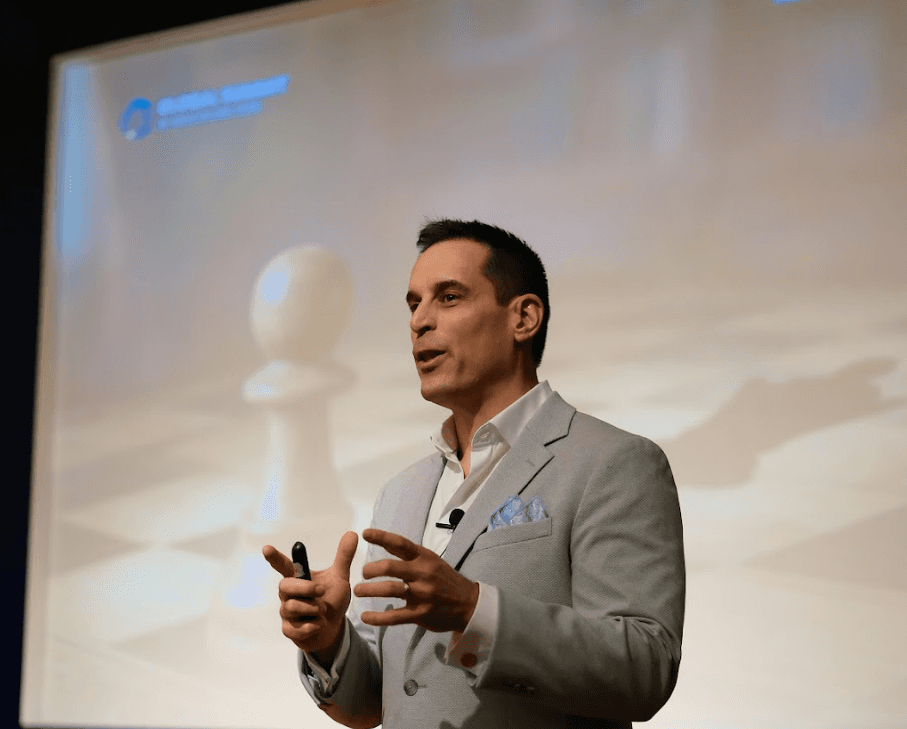
Marc ended with a chess analogy. A pawn that sits still gets taken off the board. A pawn that moves with intention can cross the board and become the most powerful piece in the game.
We are all players inside systems. The AI era will not wait for anyone, but it is not a binary choice between relevance and obsolescence either. The answer is not fear. It is movement. Understand where you stand, get your hands into the tools, and move with intention.