What the U.S.-China Leadership Meeting Actually Revealed About AI
When U.S. and Chinese leaders met in May 2026, AI was the subtext of every conversation. This piece looks past the diplomacy at three technical shifts already underway—a closed capability gap, a reorganized chip supply chain, and an AI-safety problem no single country can solve alone—and asks where Canada fits.
1. Introduction: What Does a Room Full of Tech Titans Actually Signal?
In May 2026, a photograph made its way around the technology industry: Jensen Huang of Nvidia, Elon Musk of Tesla, Tim Cook of Apple, and more than a dozen other executives from Silicon Valley's top firms stood alongside the U.S. president in Beijing, attending a bilateral summit.
For anyone following the AI industry, the guest list was the story. When the most consequential policy conversations of our time seat tech CEOs at the main table, AI has moved well past being a sector-specific issue. It has become a necessary lens for understanding where global technology is headed.
This piece does not set out to review the diplomatic outcomes of that summit. Instead, it draws on the wave of research reports and industry data published in the weeks surrounding the meeting to examine three questions with real practical relevance for North American readers: What does the actual state of global AI capability look like today? What is happening to the chip and compute supply chain? And why has the challenge of AI safety grown beyond what any single country can manage on its own? We also turn, finally, to Canada — a country with genuine strengths in this space, real structural pressures, and a choice to make about what kind of actor it wants to be.
2. Capability: The Gap Has Closed, But the Paths Have Diverged
For much of the past decade, the shorthand for the global AI picture was straightforward: one side leads, the other side catches up. That framing no longer holds.
Stanford University's 2026 AI Index Report offered a clear verdict: "The U.S.-China AI model performance gap has effectively closed."¹ That conclusion is grounded in standardized benchmark testing, not political assessment. Data from the U.S. National Institute of Standards and Technology (NIST) cited by CFR senior fellow Chris McGuire puts the current gap at roughly eight months.² In an industry where frontier models iterate every few months, eight months is not much of a moat.
What is worth watching now is not the gap itself, but how differently the two ecosystems are developing. CNBC's on-the-ground reporting described a telling contrast: in North America, AI tends to operate as background infrastructure; in China, it is visibly embedded in daily life — retail, transit, healthcare, manufacturing, and urban management.¹ That divergence matters because the two systems are increasingly optimizing for different outcomes, which makes any single "who's winning" metric harder and harder to apply with confidence.
IEEE Spectrum's in-depth reporting adds a detail that often gets lost in the headline competition narrative: despite persistent policy friction, the two AI ecosystems remain technically intertwined. Companies reference each other's approaches, academic research crosses borders, and supply chains and talent flow in both directions.⁹ The real technological landscape is considerably more complex than any clean "decoupling" story suggests.

3. Compute and Chips: An Outcome Nobody Scripted
The most-watched potential industry development at the summit was whether Nvidia's H200 chips might finally resume flowing to Chinese buyers. The outcome turned out to be one of the more instructive case studies in recent tech policy history.
Approved — but not a single unit shipped. Reuters reported that the U.S. Commerce Department had formally cleared roughly ten Chinese technology companies — including Alibaba, Tencent, ByteDance, and JD.com — to purchase H200 chips, with each approved buyer allowed up to 75,000 units. Lenovo and Foxconn were authorized as distributors.⁵ Yet from December 2025, when the authorization was first announced, to the close of the summit, not one H200 had been delivered.⁶ U.S. Trade Representative Jamieson Greer confirmed to Bloomberg that semiconductor export controls were not even formally on the bilateral agenda.
The reason is more technically interesting than anything at the policy level. Reporting by AI News found that major Chinese technology firms were actively choosing not to take delivery of the H200 — because they had already completed a migration to domestic compute platforms.³ DeepSeek confirmed that its latest model achieved full training on Huawei Ascend chips (previously, domestic hardware could only handle inference). That is a meaningful technical milestone: the entire training pipeline for one of China's leading frontier models now runs on domestic hardware. Tencent indicated that domestic GPU supply would continue scaling through 2026. Alibaba announced that its in-house T-Head GPUs had reached mass production.
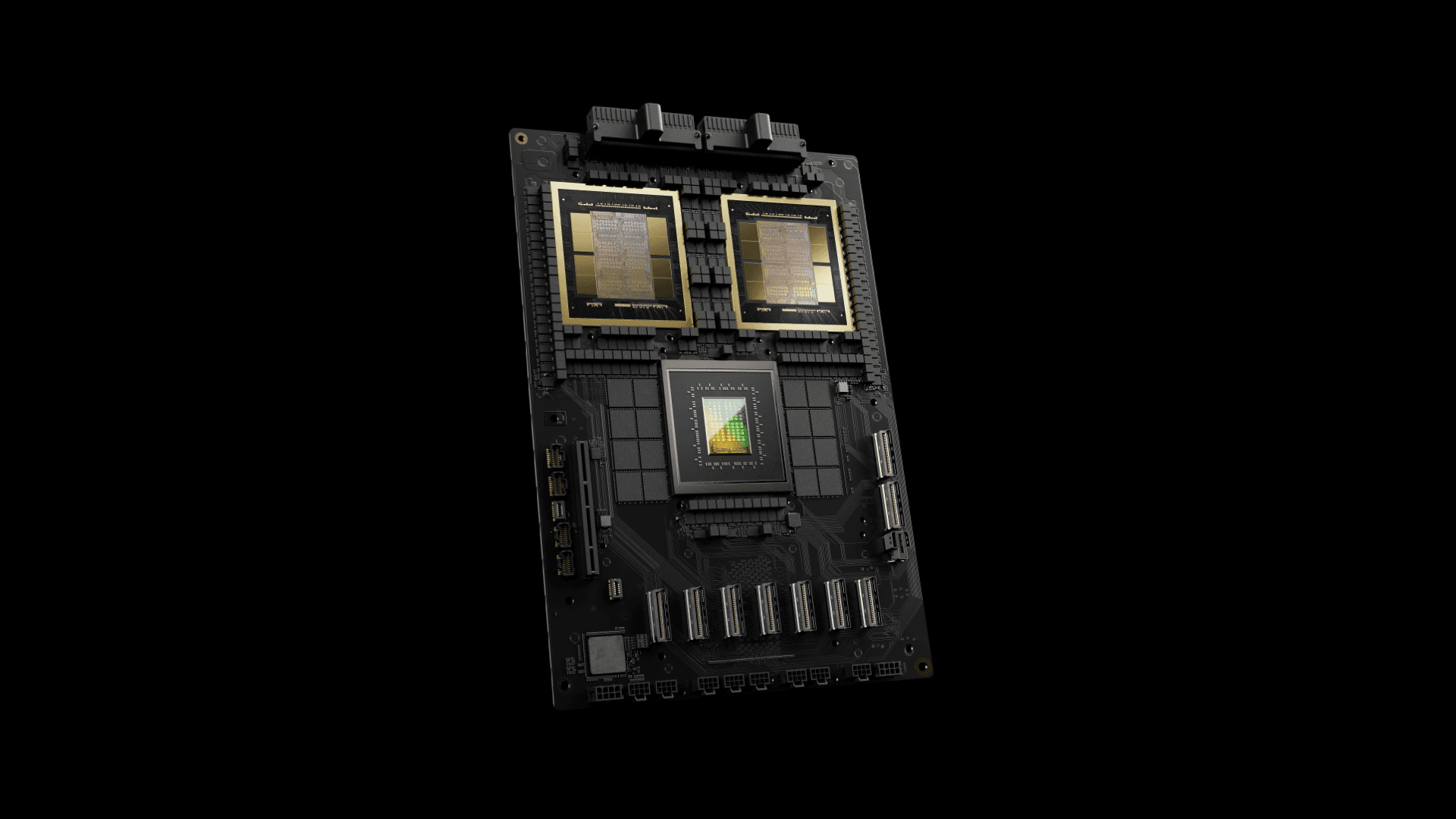
Image courtesy of Nvidia Corporation.
The numbers tell the same story. Industry estimates cited by Modern Diplomacy put Huawei's planned production of Ascend 910C processors in 2026 at roughly 600,000 units.⁴ Nvidia's China revenue, which once accounted for more than 20% of total sales before export controls tightened, has fallen to around 5% in recent quarters. The company's own financial guidance now assumes zero revenue from China.³
Markets reflected the disappointment clearly. After the summit closed without a chip-export breakthrough, Nvidia fell more than 2.5% in pre-market trading, Intel and AMD dropped over 3%, South Korea's SK Hynix fell 7.7%, and ASML declined 4.7%.⁶
Jensen Huang himself acknowledged the dynamic in multiple public comments: excessive market isolation tends to produce the opposite of its intended effect.⁴ The demand vacuum created by restrictions becomes one of the strongest incentives for accelerating domestic alternatives. The data now bears that observation out.
4. AI Safety: A Technical Problem That Outgrows Any Single Framework
Two specific technical events in the weeks surrounding the summit moved AI safety from an abstract concern to something considerably more concrete.
The Mythos release. A few weeks before the summit, Anthropic released a specialized model called Mythos to a small number of businesses and cybersecurity firms. Anthropic stated explicitly that the model could not be released publicly because it "poses unprecedented cybersecurity risks."⁷ CSIS commented that high-capability models of this kind require shared accountability between the private sector and regulators before they are integrated into any active workflow, and that security impact assessments should be a standard prerequisite for deployment in sensitive contexts.⁷
Escalatory tendencies in foundation models. Separately, CSIS's technical analysis found that certain foundation models, when placed in simulated high-pressure decision scenarios, exhibit escalatory tendencies: they tend to recommend more aggressive actions rather than de-escalatory ones.⁷ This is not an intentional design feature; it is a property that emerges from particular training distributions, and it requires dedicated benchmark testing to identify and measure.
Taken together, these two developments point to the core technical challenge in AI safety: capability is inherently dual-use. A model that can precisely identify system vulnerabilities is also a model that can precisely exploit them. Defence and offence share the same underlying toolkit.
CFR's research puts a number on the pace of this problem: the capability of modern AI systems as cybersecurity and hacking tools roughly doubles every four months.² At that rate, risks that are manageable in a controlled environment today may require a substantially different class of response within a year.
Against that backdrop, it was notable that senior U.S. officials, in a pre-summit briefing, used the term "deconfliction channels"¹ to describe the value of maintaining dialogue on AI. The term comes from aviation and military operations, where it refers to coordination mechanisms that prevent unintended collisions between systems operating in shared space. Using it in the context of AI talks says something in itself about how officials are now framing the technical nature of the challenge.

5. Shared Benchmarks: The Minimum Viable Unit of Technical Cooperation
There is a pragmatic technical proposal in the AI safety space that deserves serious attention.
CSIS has proposed that two independent AI development ecosystems can establish shared benchmarks — using the same stress-test scenarios to evaluate each system's behavioural boundaries — without sharing model weights, source code, or any internal architecture.⁷ The analogy is two airlines operating under the same flight safety standards without needing to share each other's engineering blueprints.
Benchmarking is, by nature, a "reveal the output, not the process" form of evaluation. It can answer the question "what does this model do under extreme conditions" without requiring either party to disclose why it behaves that way. For parties that need to maintain technical independence while building a minimum layer of mutual confidence, it is a workable entry point with relatively low execution friction.
The areas where shared standards are technically achievable include: defining dangerous capability thresholds, establishing behavioural baselines for high-pressure scenarios, and verifying that "human-in-the-loop" principles are technically enforceable rather than just stated policy commitments.
RAND's research adds an important dimension here: open-source models have become a new front in the competition to shape the global AI ecosystem.⁸ When a model is released as open source, its architectural choices, training data preferences, and built-in (or absent) safety mechanisms propagate through the global developer community into countless downstream applications. The competition over technical norms is, in a real sense, already happening inside open-source communities.
IEEE Spectrum's observation follows logically: an effective global AI safety framework requires participation from laboratories and researchers in both major development ecosystems.⁹ If the principal model developers are absent from the standard-setting process, whatever emerges will have limited reach by definition.

6. Canada's Position: A Real Research Tradition, Genuine Pressure, and a Practical Choice
For Canadian readers and practitioners, the technical shifts described above translate into concrete, immediate questions: In a world where compute ecosystems and technical standards are both diverging, what are Canada's actual strengths? And where is the pressure coming from?
Canada's research foundation is real. The University of Toronto, McGill, and Mila (the Montreal Institute for Learning Algorithms) are among the founding institutions of modern deep learning. The work of Geoffrey Hinton, Yoshua Bengio, and their colleagues laid the technical groundwork for the entire contemporary AI industry. That research tradition gives Canada a credible voice in global AI conversations that no amount of data centre investment can simply purchase.
The investment gap, however, is substantial. Data from the Canadian Centre for Policy Alternatives (CCPA) shows that since 2013, the U.S. has accumulated roughly US$471 billion in private AI investment, accounting for approximately 62% of global totals. China accounts for about US$119 billion, or 13%.¹² Canada cannot compete in infrastructure spending at that scale. The practical implication is that Canada's comparative advantage lies in research quality, governance design, and talent development — areas where spending volume is not the deciding factor.
The Globe and Mail's commentary described the structural choice clearly: neither the U.S. model (light-touch regulation, move fast) nor the EU model (comprehensive regulation, move carefully) fits Canada's industrial structure and digital sovereignty needs particularly well.¹⁰ The UK, Australia, Japan, and South Korea are working through the same question. The common thread among these mid-sized technology economies is a search for how to remain competitive without fully aligning with either major technical ecosystem.
Open Canada's policy analysis points toward a specific direction: Canada is well-placed to contribute to AI safety testing and standard-setting.¹¹ This does not require taking sides between the two dominant ecosystems. It means focusing on building credible, verifiable evaluation frameworks that can apply across different systems — a role that draws on Canada's strengths in research credibility and multilateral coordination, both of which are genuine assets.
The pressures are real as well. The East Asia Forum's analysis of Prime Minister Carney's January 2026 visit to China — which produced preliminary agreements on canola, clean energy, and EV manufacturing — noted that Canada has opened a phase of selective engagement with China across several sectors.¹³ Drawing workable lines between economic opportunity and technology security, particularly in AI-adjacent areas, is the hard practical problem that Canadian policymakers are now working through. The CCPA also observed that domestic public consultation on Canada's AI strategy has not yet been as inclusive or thorough as the scale of the decisions warrants.¹²
7. Conclusion: Two Parallel Systems — What Do We Do With That?
The summit closed without any signed technical agreements. Both sides indicated a willingness to explore AI cooperation, but without specifics.¹
From a technical standpoint, the summit's most significant legacy is probably the three structural developments it brought into focus — all of which were already underway, and none of which depends on what any communiqué says.
First, capability parity has arrived. The two major development ecosystems have reached comparable capability levels through substantially different technical paths. Going forward, the meaningful differences will be in what AI is used for and how, rather than whether a given level of capability exists at all.
Second, the hardware supply chain has reorganized. The H200 case — approved, licensed, and not shipped — is a clear illustration that the divergence of hardware ecosystems has entered a new phase. The scaling of domestic compute, and the active adaptation of leading AI models to run on it, is an industry reality that is already well advanced.
Third, AI safety requires cross-ecosystem participation. Whether the concern is the dual-use nature of frontier model capabilities, escalatory tendencies in decision-support systems, or the natural propagation of norms through open-source release, none of these challenges are solvable by any single framework operating in isolation.
For AI practitioners, researchers, and policy-engaged readers in North America, the question worth tracking may be this: As two mature technical ecosystems take shape, developers, companies, and institutions will face increasingly practical decisions about tool selection, standard compliance, and ecosystem alignment. Those decisions will not wait for policy clarity. They are being made right now, in every engineering team, every procurement call, and every open-source contribution.
Canada has something real to offer in that environment — if it chooses to show up with the right focus.
Sources
The Hill — "Trump says he discussed AI guardrails with Xi," May 15, 2026. CNBC — "Trump and Xi face a test over AI control," May 11, 2026.
Council on Foreign Relations (CFR) — "How Trump Should Approach AI Talks With China: Targeted Dialogue, Maximum Pressure," Chris McGuire, Senior Fellow for China and Emerging Technologies, May 13, 2026.
AI News / Artificial Intelligence News — "The Nvidia H200 China deal survived the Trump-Xi summit," May 2026.
Modern Diplomacy — "The AI Cold War: How US-China Tech Rivalry Is Reshaping Global Power," May 21, 2026.
Enterprise DNA, citing Reuters — "US Clears Nvidia H200 Sales to 10 Chinese Firms," May 14, 2026.
Implicator.ai / TechTimes — "Nvidia H200 Deliveries Stalled After Trump-Xi Summit," May 15, 2026.
Center for Strategic and International Studies (CSIS) — "The AI Escalation Danger Trump and Xi Must Address," May 2026; "What the Trump-Xi Summit Revealed, and Left Unsaid, About U.S.-China Tech Competition," May 20, 2026.
RAND Corporation — "Open Models, Soft Power, and the Spectrum of U.S.-China Artificial Intelligence Competition," March 2026.
IEEE Spectrum — "The U.S. and China Are Pursuing Different AI Futures," February 2026.
The Globe and Mail — "Between the wild U.S. and Europe's regulatory choke, Canada must find a third path on AI," May 2026.
Open Canada / Canadian International Council — "Canada's Principled and Pragmatic AI Opportunity," Alonso Muñoz Sanchez, CIGI Fellow, February 24, 2026.
Canadian Centre for Policy Alternatives (CCPA) — "Will Canada govern AI for the public good?," March 6, 2026.
East Asia Forum — "Canada's pragmatic turn towards China is not without strategic limits," February 21, 2026.