AI Investing Today: What Actually Creates Long-Term Value?
A look into how venture capital is actually evaluating AI startups today, from signal and defensibility to capital efficiency and real-world outcomes. Based on a panel at Global Summit Vancouver 2026, this piece explores why vertical AI applications, workflow ownership, and customer-driven growth are becoming more important than scale alone in the current AI investment landscape.
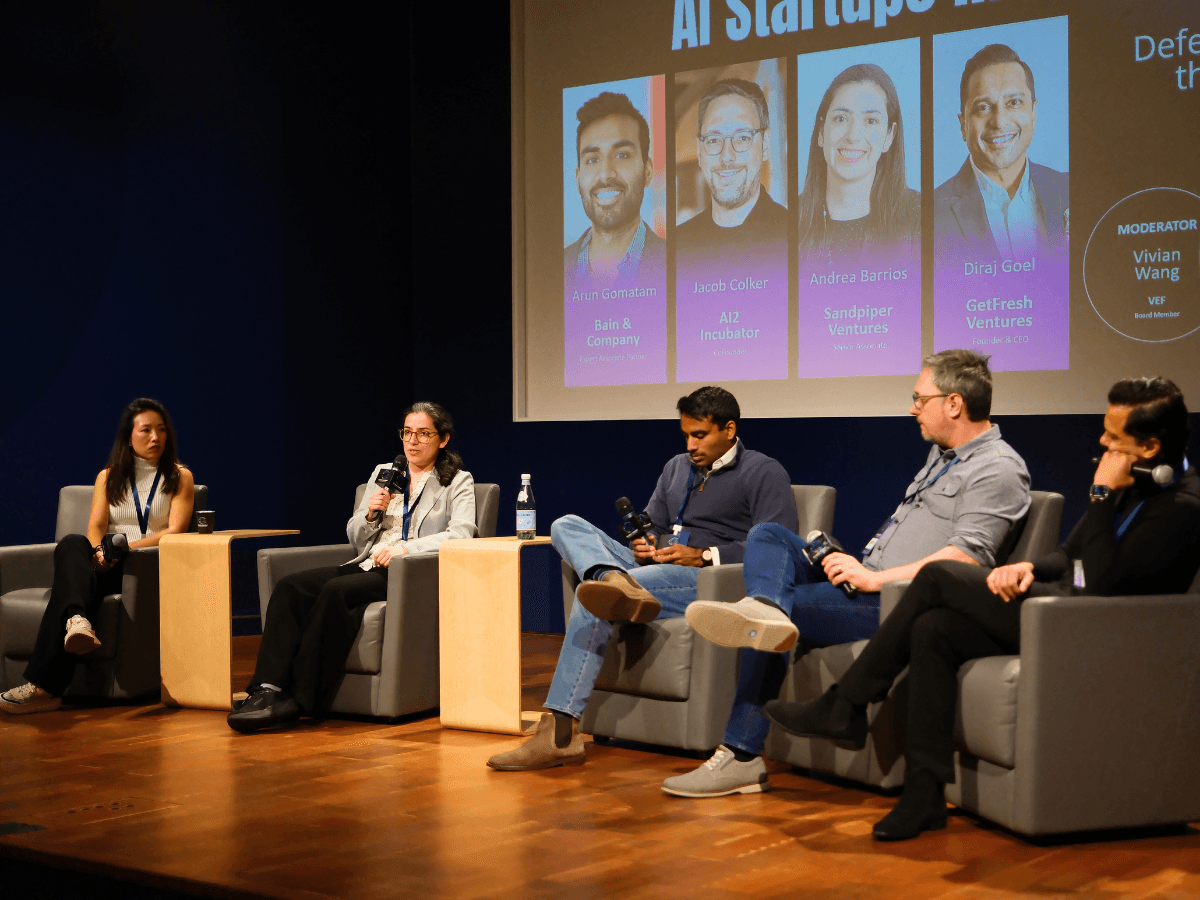
AI investing has entered a phase where capital is moving faster than clarity.
In 2025, more than half of global venture capital flowed into AI startups, with the majority concentrated in North America. By the first quarter of 2026, over $220 billion had already been deployed into the space. The scale is unprecedented, and the pace continues to accelerate.
Yet behind this surge in AI funding, a more important question is emerging:
What actually makes an AI company valuable in the long run?
This question was explored in a panel at Global Summit Vancouver, “AI Startups in 2026: Signal, Defensibility, and the Venture Reality,” moderated by Vivian Wang, with perspectives from Arun Gomatam, Jacob Colker, Diraj Goel, and Andrea Barrios.

The AI boom is masking deeper shifts in venture capital
Before the current wave of AI startups, venture capital was already undergoing a structural reset.
Between 2021 and 2022, rising interest rates pushed investors to rethink priorities. Growth began to be evaluated alongside capital efficiency and sustainability. The rise of AI shifted attention back toward rapid expansion and market capture.
This shift is unlikely to be permanent.
As more AI companies move toward IPO or acquisition, capital efficiency, burn relative to revenue, and long-term margins are expected to return as central evaluation criteria. The current phase reflects momentum, while underlying discipline remains.
Too many unicorns, not enough outcomes
One of the clearest signals in today’s venture capital landscape is the imbalance between valuations and real outcomes.
There are now close to 1,900 unicorns globally, representing nearly $2 trillion in private market value. The number of viable exits does not match this scale.
“There are not buyers for $1.9 trillion of startups.”
This imbalance is already shaping competition in subtle ways. Smaller, highly focused startups are increasingly displacing mid-stage companies that raised significant capital just a few years ago.
Scale alone is no longer protection.

Vertical AI applications are becoming the real opportunity
A major shift in AI investing is happening around where defensibility actually comes from.
Many founders continue to pursue horizontal platforms. In practice, only a small number of companies have the capital and distribution required to succeed at that level.
In contrast, vertical AI applications are showing stronger signals.
Over the past decade, a large portion of successful AI portfolios has focused on vertical companies built around specific workflows in defined industries. These businesses tend to deliver clearer value and are harder to replace.
This approach has led to tangible outcomes. Companies built around focused AI applications have been acquired by Apple, DocuSign, and Anthropic, often because they solved a very specific problem exceptionally well.
“The winners are the ones that own the workflow.”
There are millions of workflows across industries. The companies that win are often the ones that successfully own a critical part of one of them.
This is also why less obvious sectors are becoming more attractive. In industries that are operationally complex and less crowded, AI can deliver direct, measurable value and stronger long-term positioning.

The gap between real AI companies and API-driven products
As more AI startups enter the market, a distinction is becoming more visible.
Some companies are built primarily on top of existing APIs, focusing on speed and interface. These products can gain traction quickly.
However, long-term differentiation is harder to maintain.
The real gap emerges in the ability to close the “last mile.” Companies that integrate into real workflows, handle complexity, and deliver reliable outcomes are fundamentally different.
This difference becomes most visible in customer behavior.
Retention, renewal, and continued usage matter more than initial adoption. Products that become embedded in how work gets done tend to create more durable businesses.

Growth and capital efficiency are being rebalanced
For a period of time, capital allowed startups to prioritize growth with limited constraints.
At one point, it was common to see companies spending three dollars to generate one dollar of revenue, with valuations driven more by capital availability than by customer value.
That model is now being re-examined.
As companies mature, capital efficiency, burn, and unit economics are returning to the center of how businesses are evaluated. Growth remains important, but it is increasingly considered alongside how efficiently it is achieved.
Venture capital is only one path
Venture capital is often treated as the default path for startups, yet it is only one of many.
Different funds operate under different timelines, return expectations, and investment strategies. A mismatch between a company and its investors can introduce unnecessary pressure.
The capital stack is broader than many founders assume.
Grants, particularly in Canada, represent a valuable source of non-dilutive funding. Debt, angels, and alternative financing structures can all play a role depending on the business.
At the same time, one point remains consistent:
Revenue is still the most valuable form of capital.
It reflects real demand, supports growth, and allows companies to scale with more control.

A more grounded view of AI startups
AI has lowered the barrier to building and dramatically increased competition.
Products can be launched faster, replicated faster, and iterated faster.
In this environment, the companies that endure tend to share a few characteristics.
They solve real problems.
They integrate into real workflows.
They create value that customers are willing to pay for repeatedly.
The opportunity in AI remains substantial.
It is increasingly defined by how effectively companies reshape specific workflows, rather than how broadly they attempt to define a category.
Stay connected
We’ll continue to share insights from conversations like this as part of Global Summit Vancouver.
If you’re interested in how AI is actually being built, funded, and applied across industries, you can subscribe below and stay tuned for updates on our upcoming Fall edition.